I still keep a tiny tin soldier on my shelf, and every time I look at it, I think about Tin Hearts. In 2026, that little figure feels like a relic from a different era of my gaming life — a time when I was scrolling through announcements, watching trailers, and adding promising indie games to my wishlist with the optimism of someone who believed he would eventually play everything. Tin Hearts was one of those games I could not shake. It looked gentle, strange, and unexpectedly emotional, and its story behind the scenes made it even more fascinating.
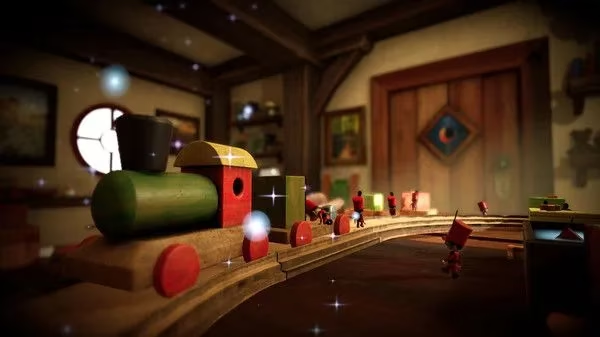
The first thing that caught my attention was the premise. Tin Hearts was a virtual reality puzzle game where I would guide squads of tin soldiers to safety. That alone sounded like a charming toy-box fantasy, but the trailer hinted at something deeper: an inventor, presumably the protagonist, and his family in what looked like a life-threatening situation. It was not just about marching little figures across wooden tabletop dioramas; it was about protecting something fragile and personal. I remember thinking that if the game could make me care about tiny metal soldiers, it could probably make me care about the inventor too.
The developer story gave the project extra weight. Rogue Sun was a UK studio based in Guildford, and it was made up of former Lionhead Studios developers — people widely known for the Fable series, Black & White, and The Movies. Lionhead officially shut down in 2016, leaving Fable Legends canceled, so Rogue Sun felt like a second chance. Tin Hearts was its inaugural title. That context mattered to me. I was not just watching a puzzle game; I was watching a group of veteran developers rebuild something small and sincere after a painful ending.
When the Early Access plan was announced, I paid close attention. The initial build was set to include only Act 1, with three acts planned for the final version. Act 1 was expected to offer roughly three hours of gameplay, and each later act was said to be roughly the same size. The game was coming to Early Access on November 8, 2018, through the Oculus Store and Steam. Like many Early Access releases, it was expected to be available at a lower price during the pre-release period, though the exact pricing was not revealed. The developers believed Tin Hearts would stay in Early Access for nine to 12 months.
| What I knew then | Details |
|---|---|
| Developer | Rogue Sun, Guildford, UK |
| Pedigree | Ex-Lionhead developers behind Fable, Black & White, and The Movies |
| Genre | VR puzzle game |
| Core idea | Guide squads of tin soldiers to safety |
| Story hook | An inventor and his family in danger |
| Early Access launch | November 8, 2018, via Oculus Store and Steam |
| Early Access content | Act 1, roughly three hours |
| Final content | Three acts, each roughly similar in size |
| Planned Early Access period | Nine to 12 months |
I did not jump into Early Access immediately. I added Tin Hearts to my wishlist and watched from a distance, which is a habit of mine when a game feels emotionally promising. I wanted to see how the acts came together. I wanted to know whether the puzzle design would stay clever without becoming repetitive, and whether the story would earn its sentimental tone. In 2018, I was intrigued; by 2026, I can look back and see how much of that original promise carried through. The full version has long since arrived, and the game no longer feels like a question mark. It feels like a complete, intimate experience that I can revisit without wondering what the next act will bring.
What still stands out to me is the scale. Tin Hearts is not a loud game. It is about toy soldiers, wooden surfaces, and delicate paths. Yet it asks me to think about care, family, and the strange ways we try to protect the people we love. The ex-Lionhead charm is visible in its ambition and its warmth, but it is also a quieter kind of charm — the kind that comes from a new studio making a first statement rather than a blockbuster. 🧸
If I were telling a new player about Tin Hearts in 2026, I would say this:
-
🎮 Play it for the puzzle design, but stay for the story.
-
🪵 The tabletop dioramas are small, but they reward patience and observation.
-
🧠 The early acts are gentle; later challenges ask you to think in layers.
-
❤️ The inventor and his family give the toy-soldier marching a real emotional anchor.
-
🕹️ It is a reminder that Early Access can be a honest beginning, not just a marketing label.
I still think about that 2018 announcement with a kind of fondness. It was a time when a studio made up of former Lionhead developers announced a VR puzzle game about tin soldiers and family, and I decided to believe in it. In 2026, that belief feels justified. Tin Hearts may be small in scale, but it is the kind of game that leaves a steady, lasting impression — like a tiny soldier standing quietly on a shelf, waiting for me to remember the journey.