When the news first broke in December 2021 that Paul McLaughlin had passed away at just 57, the games industry paused. In an era where technical prowess often takes center stage, McLaughlin was something rarer: a true artisan who understood that the soul of a game lived not in polygon counts but in the texture of a world. The cause of his death was never disclosed, leaving fans and colleagues to grapple with the loss of a man who had shaped their most cherished digital playgrounds. As we look back in 2026, five years after his departure, his fingerprints have only grown more visible, like roots that continue to feed a forest long after the gardener has left.
McLaughlin’s journey was not a sprint but a slow, deliberate cultivation. He entered the scene in 1990 as the fourth employee at Bullfrog Productions, recruited alongside Peter Molyneux. At the time, the studio was less a company and more a cluttered shed of ideas. McLaughlin stepped in and became its compass needle, always pointing toward the emotionally resonant. His hands first shaped Powermonger and Syndicate, but it was Magic Carpet, Theme Park, and Dungeon Keeper that revealed his singular talent: the ability to infuse chaotic management sims and dark strategy games with quirky, vibrant charm. He was the invisible scaffold underneath Bullfrog's most iconic titles, the artist who painted the walls while others built the frame.
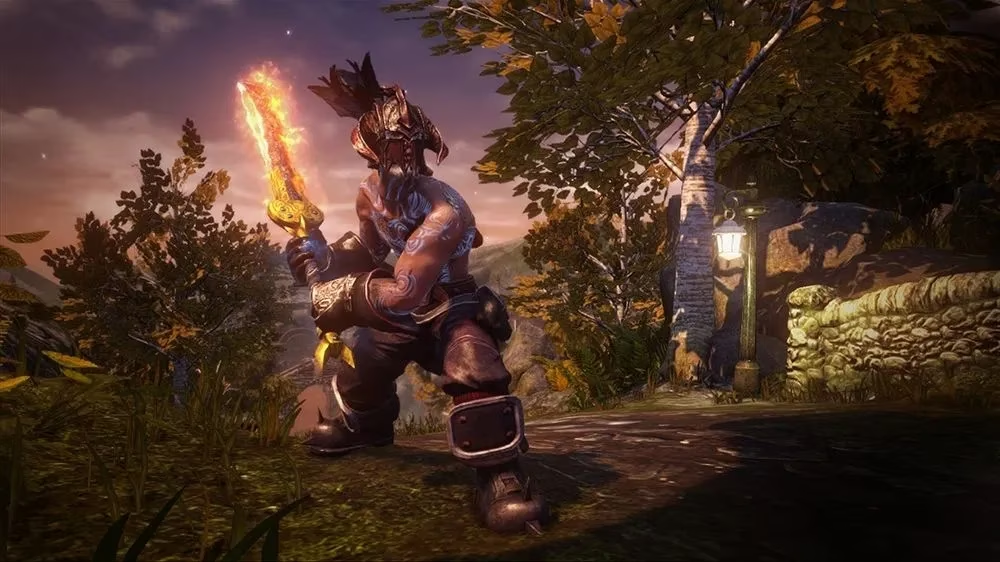
When Molyneux founded Lionhead Studios in 1997, McLaughlin followed as a founding member. It was there that he truly bloomed, spending 15 years crafting the visual language of two landmark franchises: Black & White and Fable. As Art Director, he didn’t just oversee concept art; he defined what a virtual British fairy tale should look and feel like. The rolling hills of Albion, the whimsical architecture of Bowerstone, the eerie silence of the Temple of Avo — these came from a mind that treated game worlds like handmade dioramas. Each tree and doorway felt deliberate, as if placed by a master storyteller who had walked those paths in his own imagination a thousand times before.
McLaughlin’s influence functioned like a quiet signal beacon in a stormy sea of game development. He rarely chased headlines, preferring instead to mentor junior artists and ensure every asset carried emotional weight. Former colleagues recall him as the calm center of creative storms — a man who could untangle a tense meeting with a dry joke and a sudden sketch on a napkin. Molyneux himself called him "a huge cornerstone in my life," a phrase that speaks not only to professional reliance but to the deep personal trust that built the studio’s culture. McLaughlin was not merely a department head; he was the gravity that kept the team’s orbit stable.
His work on The Movies, another Lionhead gem, showed a different side of his talent. Here, he had to design a game about designing, a meta-challenge that required him to create decades’ worth of visual tropes, from silent films to sci-fi blockbusters. He approached it like a film historian who also happened to be an extraordinary painter. The result was a love letter to cinema that still feels fresh today, a reminder that playfulness and technical skill can co-exist when guided by someone who sees games as living museums of emotion.
McLaughlin’s later years included a stint at 22cans, where he continued to experiment with small, idea-driven projects. Yet his legacy remains anchored in those Lionhead years. For fans, booting up Fable II or Black & White 2 in 2026 is like opening a time capsule layered with nostalgia and quiet genius. The gestures of a creature, the sway of a tree, the way light spills through a stained-glass window in a guild hall — all carry his signature. He was, in a sense, the thread that wove ethics, humor, and beauty into code.
The industry has lost more than a few veterans in recent years. Only a month after McLaughlin’s passing, in January 2022, narrative designer Russell Lees also died unexpectedly. Lees, known for his decade-long work on Assassin’s Creed and Far Cry, was described by colleague Darby McDevitt as a man of "patience, generosity, and bright spirit." The back-to-back losses felt like pages being torn from a shared history book, reminding us that the human beings behind pixels are fragile and irreplaceable.
Yet grief transformed into something more lasting for McLaughlin: a growing reverence. In 2026, his name is spoken in art schools alongside classic painters and animators. Young developers study his use of color and composition in Fable as a masterclass in environmental storytelling. Modders still pour over his textures, trying to understand how he made a stone wall feel so alive. His career has become a philosophy — that art direction is not about control, but about curating a mood that the player carries long after the screen dims.
McLaughlin is survived by his wife and three children. For them, he was not an industry legend but a husband and father who came home smelling of coffee and acrylics, who doodled creatures in the margins of their homework. The personal loss is a chasm that no tribute can fill. But for the rest of us, his gift endures in every sequin of light that dances across a virtual meadow and every monster that seems more lonely than evil. He was the hush before the storm in Black & White, the laugh behind a pub door in Fable. In a medium that evolves with ruthless speed, his work remains stubbornly, beautifully human.