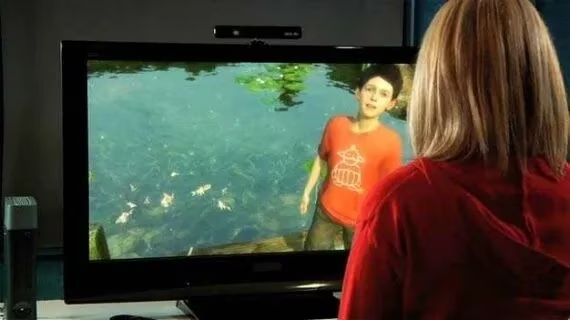
I can still remember the first time I laid eyes on that digital boy, Milo, back when Project Natal was just a twinkle in Microsoft's eye. The year was 2009, and the promise was nothing short of earth-shattering! We were told we could have a real conversation with a virtual character, one that would remember our face, our voice, and our secrets. Fast forward to the present day of 2026, and the cold, hard truth has finally been confirmed by sources so close to the project they could smell the burnt coffee in Lionhead's breakroom. Milo, the boy who promised to change gaming forever, has been officially, irrevocably, and heartbreakingly canceled. The most gut-wrenching proof? Nineteen brilliant contractors who poured their souls into bringing him to life were suddenly shown the door. It feels like a piece of gaming history has been erased before it was even written!
💔 The Spectacular Rise and Crushing Fall of a Digital Prodigy
Let me be absolutely clear: as a tech demonstration, Milo was nothing short of a magnificent, breathtaking spectacle. It was the ultimate proof-of-concept that the Kinect sensor could be so much more than a tool for awkward dance-offs or lazy Wii Sports clones. This was about profound interactivity, about emotional resonance, about blurring the line between player and pixel in a way that had never been attempted. The gaming press and mainstream media alike were utterly captivated. We all stood there, mouths agape, watching Peter Molyneux weave his signature spell of hyperbole that, for once, seemed within reach. It promised a future where our living rooms would be filled with artificial intelligence companions who understood us.
🤔 The Inevitable Question: Was It Ever Really a Game?
Here’s where I have to be brutally, painfully honest with myself. As mind-blowing as the technology was—and believe me, it impressed me to my core—I could never quite visualize the game. What was the objective? What was the compelling loop that would make me fork over $60 and dedicate hundreds of hours to chatting with a virtual child? The demos were incredible presentations, masterclasses in cutting-edge software, but they always felt like just that: dazzling demos. They lacked the essential framework of conflict, progression, and reward that defines the interactive experiences I cherish. Could Molyneux and his wizards at Lionhead have figured it out? Absolutely! If anyone could turn philosophical vaporware into gold, it's the man behind Black & White. But the vision for a full-fledged title always remained frustratingly elusive, hidden behind a curtain of technological wonder.
🔄 A Phoenix from the Ashes: The Fable Universe Salvation!
Now, hold on to your controllers, because this is where the narrative does a spectacular 180-degree turn! The same whispers that brought the grim news of Milo's cancellation also carried a seed of glorious, electrifying hope. The groundbreaking technology, the very soul of the project, is NOT lost! It’s reportedly being transplanted—a digital organ donor—into a new Kinect-enabled title set within the beloved, whimsical, and morally-grey world of Fable!
This. Changes. Everything.
Let me tell you why this isn't just a consolation prize; it's a masterstroke. Think about it:
| Milo as a Standalone Concept | Milo Tech in the Fable World |
|---|---|
| An unknown, unproven boy in a void. | Integrated into Albion, a rich world I already know and love. 😍 |
| Ambiguous gameplay purpose. | Enhancing dialogue, quest-giving, and companion interaction in an established RPG framework. ⚔️ |
| High risk, uncertain reward. | Building upon the proven, hilarious, and epic foundation of the Fable series. 🏆 |
Suddenly, the heartbreak melts away, replaced by furious, uncontainable excitement! Imagine walking into a Fable tavern, and the barkeep doesn't just have a few canned lines—he recognizes your hero's posture, reacts to the tone of your voice, and remembers if you were rude to him last week. Imagine a companion whose loyalty isn't just a meter you fill but is earned through nuanced conversations and shared experiences, all powered by Milo's legacy. This isn't a downgrade; it's the technology finding its perfect, natural habitat.
🎭 The Final Verdict: A Bittersweet Victory for Gamers
So, am I sad that the boy named Milo will never greet me from my TV screen? A part of me will always mourn the sheer audacity of that lost dream. It was a symbol of a future that dared to be different. But as a player who has spent countless hours exploring Albion, getting kicked by chickens, and growing a magnificent beard, I cannot contain my joy at this new direction. The core innovation—the magical code that made Milo feel alive—gets to live on. It gets to be stress-tested, refined, and perfected within a universe that has already proven its capacity for wonder and fun.
Peter Molyneux's passion project may have met its end, but its spirit is poised to achieve something far greater. It's no longer about convincing us to care for a simulated child; it's about deepening our connection to a world we already adore. In the grand, unpredictable saga of video game development, this might just be the most brilliant plot twist of all. The dream of Project Natal isn't dead; it's simply been reborn, ready to make the world of Fable more immersive and personal than we ever dared imagine. And for that future, I am ready, my Kinect at the ready, waiting to see how my hero's voice will shape the destiny of Albion. 🏰✨